AI-Orchestrated Smart City Operations

Modern cities don't need more systems. They need better coordination.
As data, infrastructure, and services become increasingly interconnected, cities need a way to align AI, people, and systems within a unified operational framework.
By combining AI orchestration, human oversight, and connected infrastructure, cities can move from fragmented operations to coordinated, real-time decision-making.

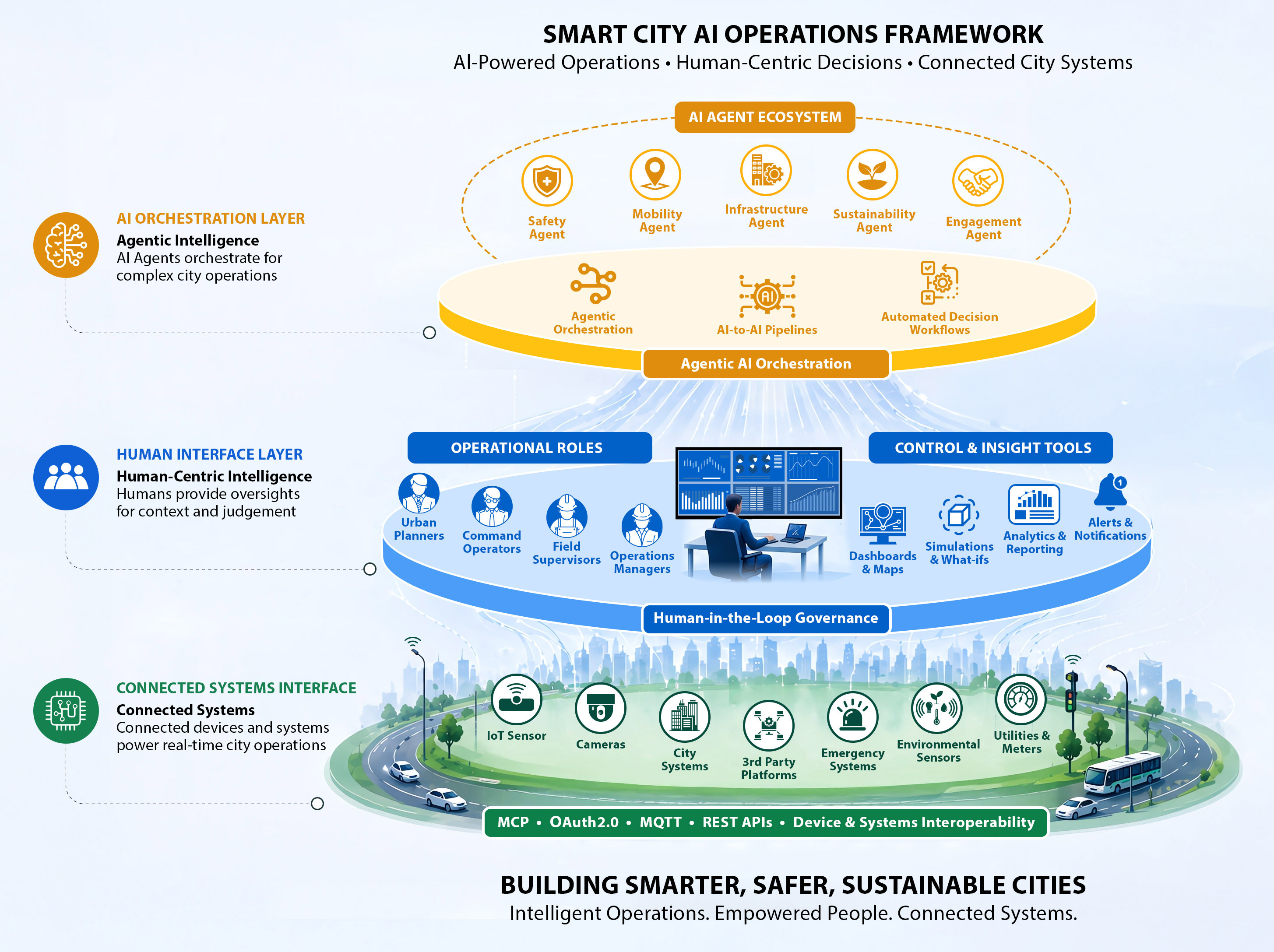
A Three-Layer Operating Model

AI Orchestration Layer

A network of domain-specific AI agents continuously monitors, analyses, and coordinates operations across key city functions, including public safety, mobility, infrastructure, sustainability, and citizen services.Rather than operating independently, these agents work as a collaborative ecosystem, sharing context, triggering workflows, and coordinating actions across departments and systems.

Key Capabilities:

  • Cross-functional AI collaboration across city services
  • Real-time workflow orchestration and automation
  • Intelligent prioritisation of incidents and actions
  • AI-to-AI coordination for faster response and execution
  • Automated escalation when human intervention is required
The result is a continuously adaptive operational layer that enables cities to move from fragmented operations to coordinated, real-time management.

Human Interface Layer

While AI accelerates operations, human oversight remains central to governance, accountability, and decision-making.
Command operators, planners, supervisors, and city managers interact with the system through dashboards, analytics, simulations, alerts, and real-time operational insights. These tools provide visibility across city-wide operations while allowing teams to review, validate, and guide decisions when human judgement is needed.

Key Capabilities:

  • Real-time operational visibility
  • Human-in-the-loop decision-making
  • Transparent and explainable AI recommendations
  • Governance and compliance oversight
  • Intervention and approval at critical checkpoints
This approach ensures transparency, accountability, and human oversight across city operations.

Connected Systems Interface

At the foundation is a connected systems layer that unifies devices, platforms, sensors, enterprise applications, and third-party infrastructure into a single interoperable ecosystem.
Operational data flows continuously across IoT devices, cameras, emergency systems, utilities, environmental monitoring platforms, transport networks, and external systems through standard APIs and interoperable protocols.

Key Capabilities:

  • Real-time data integration across city systems
  • Unified situational awareness
  • Interoperable connectivity between physical and digital infrastructure
  • Seamless execution of operational decisions
  • Scalable integration of new systems and services
By connecting previously isolated systems, cities gain the ability to respond faster, automate intelligently, and scale operations more effectively.

Together, these three layers create a unified operating model where AI coordinates, humans govern, and connected systems execute.

From Coordination to Outcomes

When these three layers work together, cities move beyond reactive management to adaptive, intelligence-driven operations.
The result is a more connected and responsive urban environment that can optimise resources, accelerate decision-making, and coordinate services more effectively.

Key Outcomes:

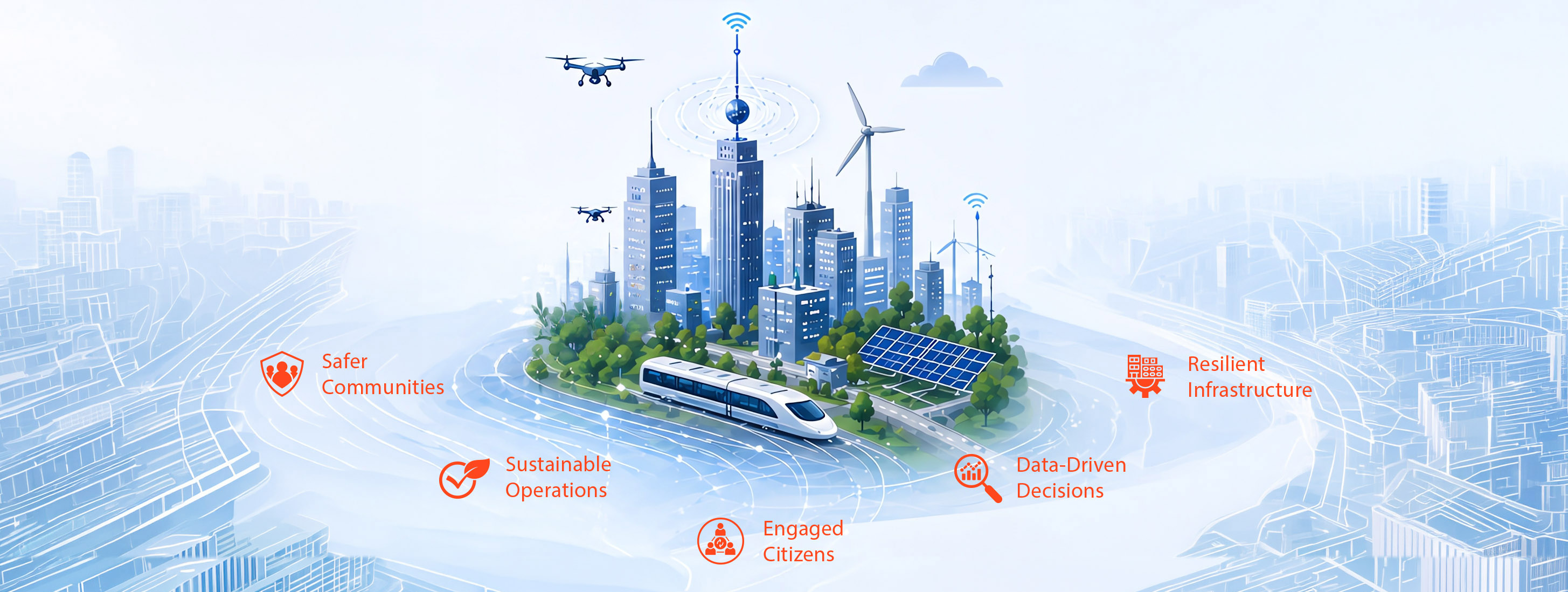
  • Safer communities through faster incident detection and response
  • More sustainable operations through data-driven resource optimisation
  • Better decisions powered by real-time insights
  • Stronger citizen engagement through improved service delivery
  • More resilient infrastructure through proactive monitoring and coordination

A Practical Shift, Not a Reset

Modernising city operations doesn't require replacing existing systems.
Instead, cities can introduce orchestration incrementally, improve interoperability, and layer AI capabilities onto current infrastructure. This approach minimises disruption while maximising the value of existing investments.

Key Benefits:

  • Build on existing infrastructure
  • Reduce implementation risk
  • Improve interoperability across systems
  • Scale AI adoption progressively
  • Accelerate operational modernisation
The transformation comes from integration, operational visibility, and intelligent orchestration, not from rebuilding entire environments from scratch.

Enabling Orchestration with Elixir Allegro

Elixir Allegro serves as the orchestration layer that connects AI, people, and systems across city and enterprise operations.
It enables organisations to coordinate AI agents, automate workflows, integrate disparate systems, and execute decisions within a structured governance framework.

Key Capabilities:

  • AI agent collaboration and coordination
  • Cross-system workflow orchestration
  • Interoperable connectivity across platforms
  • Structured decision execution
  • Human oversight and governance controls
This enables organisations to operationalise AI in a practical, scalable, and controlled manner, delivering measurable outcomes without introducing unnecessary complexity.
Contact us to find out more.